
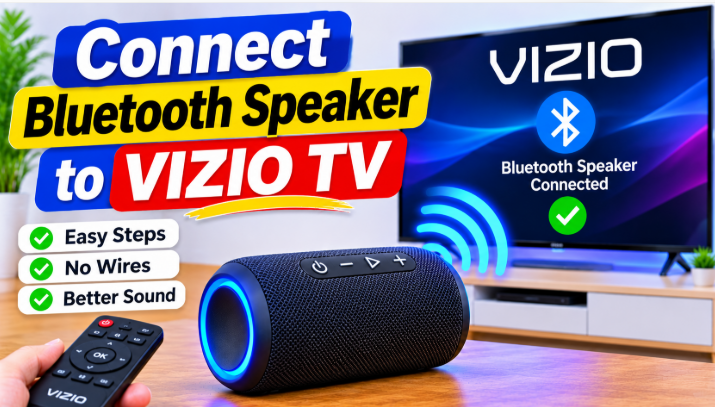
Quick answer: Here’s how to connect Bluetooth speaker to Vizio TV: put the speaker in pairing mode, press Menu on your Vizio remote, and look for Bluetooth Headphones or Pair Headphones. Then select your speaker when it appears, and enter PIN 0000 if it asks. But first check the menu exists at all — many Vizio TVs, especially budget D-Series and older models, have no Bluetooth audio, and the spec sheet saying “Bluetooth” is not proof. One device at a time.
Vizio is the TV brand most likely to waste your evening — not because pairing is hard, but because many Vizio TVs have no Bluetooth audio at all, and the spec sheet still says “Bluetooth”. That Bluetooth is often only for the remote, not for sound. Other brands in this series — Samsung, LG, Sony, TCL, Hisense — all pair speakers directly on most models. Vizio is different: only certain SmartCast sets support it, and the menu that proves it is called “Bluetooth Headphones”, not “Bluetooth”. This guide starts with the 30-second check that tells you whether your Vizio can do it at all, then gives the exact pairing steps, the SmartCast app myth, and the transmitter route for the many Vizio TVs that can’t.
How to Connect Bluetooth Speaker to Vizio TV
The whole job is four moves, and they’re the same on every Vizio TV that supports Bluetooth audio. First, put the speaker in pairing mode — usually by holding its Bluetooth button for 3 to 5 seconds until the light flashes. Second, press Menu or the Settings gear button on your Vizio remote and find the Bluetooth Headphones option. Third, select Add Device or Scan for Devices and wait for the scan. Fourth, select your speaker when it appears in the list. If you’ve paired a speaker with a phone before, this will feel familiar — our pairing guide explains the pairing-mode part in detail. Keep the speaker within 5 metres of the TV while you pair, and make sure the speaker isn’t already connected to your phone — a speaker can only play from one device at a time. Once paired, the TV reconnects to the speaker automatically every time you turn it on.
First: Does Your Vizio TV Have Bluetooth Audio?
Before you touch any menu, check whether your Vizio can send sound over Bluetooth at all — this is the step every other guide skips, and it’s the one that matters most on Vizio. Press Menu or the Settings gear button on your remote and look for an option called “Bluetooth Headphones” or “Pair Headphones”. If you see it, your TV supports Bluetooth audio. If you only see a generic “Bluetooth” line in the specs or the settings, that proves nothing — Vizio uses Bluetooth for the voice remote on many models, and that Bluetooth can’t carry sound. Vizio’s own product pages make the same split: some models say “Bluetooth Compatible” and others say “Bluetooth headphone capable” — only the second phrase means the TV will send audio to a wireless device. Documented models with the feature include the 2022 V-Series and D-Series (Menu, then Bluetooth Headphones) and the 2023 Quantum Pro (Bluetooth listed as an audio output beside HDMI eARC and optical). Current 4K and Full HD models with Bluetooth 5.2 or 5.0 also support it. If your model is a budget D-Series or an older V-Series or E-Series, it probably has no Bluetooth audio — skip to the transmitter section below instead of wasting twenty minutes in the menus. And update the firmware first: Vizio’s support notes say firmware 1.510.21.1-1 or newer is often required, so go to Settings, then System, then Check for Updates before you pair. Our generic TV guide covers the transmitter route that works on any TV.
How to Connect Bluetooth Speaker to Vizio TV (SmartCast Models)
On a Vizio SmartCast TV that supports Bluetooth audio, here’s the exact route:
- Put the speaker in pairing mode. Turn the speaker on, then press and hold its Bluetooth button for 3 to 5 seconds until the light flashes. Turn off your phone’s Bluetooth first if the speaker keeps connecting to the phone.
- Press Menu or the Settings gear button on your Vizio remote. Navigate to the Bluetooth Headphones option. On some models the path is Settings, then System or Network, then Bluetooth; on others it’s Settings, then Remotes & Devices, then Bluetooth. The 2024 HD and Full HD manuals call it Menu, then Pair Headphones.
- Select Add Device or Scan for Devices. The TV searches for nearby Bluetooth devices. If your speaker doesn’t appear in the first list, select More Devices to expand the search.
- Select your speaker when it appears. Tap its name in the list. If it asks for a PIN, try 0000 or 1234.
- Check the sound comes out of the speaker. Play something on the TV. If the sound still comes from the TV speakers, check the audio output in the sound settings and select the Bluetooth device as the output.
Two limits to know. First, most Vizio TVs support only one Bluetooth audio connection at a time — connect a second one and the TV either disconnects the first or warns you that only one device can be connected. Second, Bluetooth audio lags a little behind the picture — standard SBC audio takes roughly 150 to 300 milliseconds. Our codecs guide explains why, and our sound-delay guide covers the delay in detail. A speaker with aptX Low Latency support cuts it to around 40 milliseconds — but both the TV and the speaker must support the same codec, or you’re back to standard lag.
The SmartCast App Myth: What the App Can and Can’t Do
Many guides tell you to pair the speaker through the Vizio SmartCast app on your phone. That doesn’t work — and it’s worth saying plainly, because it’s the most common wrong advice about Vizio. The SmartCast app uses Bluetooth LE (Low Energy) to talk to the TV during setup, and speakers need Bluetooth Classic — a different kind of Bluetooth that the app can’t use for audio. The app is useful for one thing: it’s a remote control for the TV, and you can use it to open the TV’s settings menu if your physical remote is lost. But the speaker itself must be paired from the TV’s own menu — Menu, then Bluetooth Headphones — never from the app. If a guide tells you to tap “Bluetooth Speakers” inside the app, close it. The same honesty applies to Hisense’s VIDAA app and TCL’s Roku app: the TV menu is the only place pairing happens. Our Hisense TV guide and our TCL TV guide both cover the same rule on their own platforms.
No Bluetooth? The Transmitter and HDMI Extractor Routes
If your Vizio has no Bluetooth Headphones option, you still have two ways to get wireless sound — and both work on any Vizio TV.
Route 1: A Bluetooth transmitter. Plug a small transmitter into the TV’s headphone jack, optical output, or RCA output (with a 3.5mm adapter for RCA), put the speaker in pairing mode, press the pairing button on the transmitter, and select the speaker when it appears. It costs about $15 to $35, and it works on every Vizio model because it doesn’t use the TV’s Bluetooth at all. This is also the fix if your Vizio pairs but the sound lags. A transmitter with aptX Low Latency cuts the delay to around 40 milliseconds, and some transmitters can connect two speakers at once, which the TV itself can’t do.
Route 2: An HDMI audio extractor. If your Vizio has no headphone jack and no optical output, connect an HDMI audio extractor to the TV’s HDMI port, then pair a Bluetooth transmitter to the extractor. It’s one more box in the chain, but it works on the cheapest Vizio sets that have no audio output at all.
Route 3: A Roku streaming device. If you use a Roku stick or box on your Vizio TV, you can use the Roku app’s Private Listening — TV audio goes to the phone over Wi-Fi, then to a Bluetooth speaker paired with the phone. Our Roku guide covers that route in detail.
If you’re choosing between a speaker and a soundbar for the TV, a soundbar connects over HDMI ARC or optical and has no Bluetooth delay at all — our speaker vs soundbar comparison explains the difference. But for a portable speaker you already own, the transmitter gets you there for the price of a takeaway.
When It Won’t Pair or the Sound Lags
If the speaker doesn’t appear in the TV’s list, work through these in order — the first two fix most cases:
- The speaker is still connected to your phone. A speaker paired to a phone grabs the phone first and ignores the TV. Turn off your phone’s Bluetooth, put the speaker back in pairing mode, and scan again from the TV.
- The TV’s firmware is old. Vizio’s support notes say firmware 1.510.21.1-1 or newer is often required for Bluetooth audio. Go to Settings, then System, then Check for Updates, install any update, and try pairing again.
- The TV needs a restart. A frozen Bluetooth stack on the TV blocks the scan. Restart the TV from its settings menu, then try pairing again from a cold start.
The Last Three Fixes
- The lips don’t match the sound. Bluetooth audio lags 150 to 300 milliseconds behind the picture on most Vizio models. Some Vizio TVs have an audio-sync setting in the sound menu — try it first. If there’s no setting, or it doesn’t fix it, the fix is a speaker with aptX Low Latency support, or a transmitter with aptX Low Latency, or a wired connection for films where the delay bothers you. Our sound-delay guide explains the delay in detail.
- The sound keeps cutting out. The speaker is paired but the audio stutters. Move the speaker closer to the TV — within 5 metres — and keep it away from the Wi-Fi router, which crowds the same 2.4 GHz band. Our cutting-out guide covers the interference causes in detail.
- The TV paired but stays silent. Check the audio output in the TV’s sound settings and select the Bluetooth device. If the TV speakers are still on, the sound may be split between them — disable the TV speakers so all audio goes to the Bluetooth device.
The Bottom Line
The bottom line is simple: check for the Bluetooth Headphones menu first — if it’s not there, your Vizio probably has no Bluetooth audio, and no amount of menu-hunting will find it. If it is there, pair through Menu, then Bluetooth Headphones, with PIN 0000 if it asks, and update the firmware first if the pairing fails. Don’t pair through the SmartCast app — it can’t do it. And if there’s no Bluetooth audio at all, a $15 transmitter or a Roku device gets you the same wireless sound. And if you’re picking a speaker for the TV, our buying guide lists sound quality and battery life as two of the 7 checks — and our best outdoor party speaker guide rounds up the portable picks if you’re shopping.
FAQs: How to Connect Bluetooth Speaker to Vizio TV
How to connect Bluetooth speaker to Vizio TV?
Put the speaker in pairing mode, press Menu on your Vizio remote, look for Bluetooth Headphones or Pair Headphones, select your speaker when it appears, and enter PIN 0000 if it asks. First check the menu exists — many Vizio TVs have no Bluetooth audio.
Does every Vizio TV have Bluetooth?
No. Many Vizio TVs, especially budget D-Series and older V-Series and E-Series models, have no Bluetooth audio output at all. A spec sheet saying “Bluetooth” is not proof — it may be Bluetooth for the remote only.
Can I connect a Bluetooth speaker through the Vizio SmartCast app?
No. The SmartCast app uses Bluetooth LE for setup, and speakers need Bluetooth Classic. Pair the speaker from the TV’s own menu — Menu, then Bluetooth Headphones — never from the app.
Can I connect two Bluetooth speakers to a Vizio TV?
No — most Vizio TVs support only one Bluetooth audio connection at a time. A second one disconnects the first. A transmitter that supports two connections is the workaround.
Why is there no sound from my Vizio TV Bluetooth speaker?
Check the audio output in the TV’s sound settings and select the Bluetooth device. If the TV speakers are still on, disable them so all audio goes to the Bluetooth device.
How do I fix Bluetooth audio delay on a Vizio TV?
Try the audio-sync setting in the sound menu first. If there’s no setting, use a speaker or transmitter with aptX Low Latency support, which cuts the delay to around 40 milliseconds.