
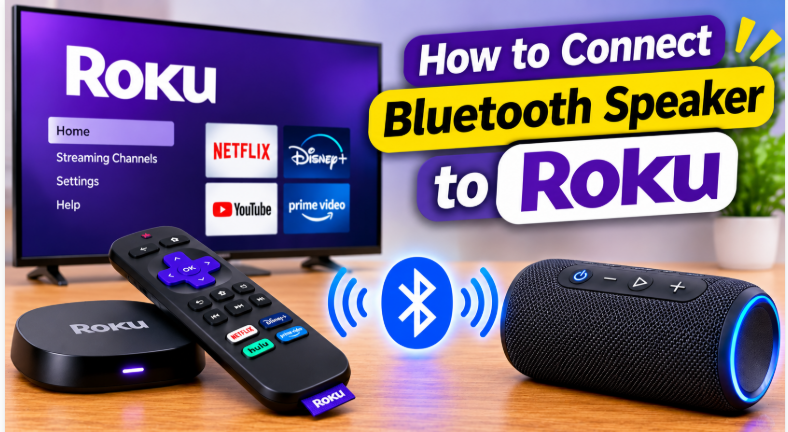
Quick answer: Here’s how to connect Bluetooth speaker to Roku: put the speaker in pairing mode, then go to Settings → Remotes & Devices → Pair Bluetooth Device and select your speaker. That’s it — but first check the option is actually there, because not every Roku supports Bluetooth audio. Most newer Roku TVs, the Streambar, and the Smart Soundbar do, while most streaming sticks don’t. The steps below cover pairing, the app workaround for sticks, and the fixes.
TV speakers are thin. Everybody knows it. A Roku TV fixes it the same way a Firestick does — with Bluetooth. The catch is that Roku is pickier than the Firestick: every Firestick has Bluetooth, but only some Rokus do. If yours is one of them, pairing takes about a minute. If it isn’t, there’s still a way — through the Roku app on your phone — and this guide covers both.
How to Connect Bluetooth Speaker to Roku
You need three things: a Roku that supports Bluetooth audio, a charged Bluetooth speaker, and the Roku remote. The quick test takes ten seconds: go to Settings → Remotes & Devices and look for “Pair Bluetooth Device”. If it’s there, your Roku can pair a speaker directly — the steps below work. If it’s not there, skip to the app method below; your Roku’s Bluetooth is for the remote only. The speaker pairs with the Roku itself, not the TV — which is why this also works on a Roku Streambar or Smart Soundbar. If you’ve never put a speaker into pairing mode before, our pairing guide explains it in general; the Roku steps below are the same idea, in Roku’s menu. And if your TV isn’t a Roku TV at all, our TV guide covers the general TV method instead.
Before You Start: 3 Roku Limits to Know
- Not every Roku supports Bluetooth audio. Most newer Roku TVs, the Roku Streambar, Streambar Pro, and Smart Soundbar do. Most streaming sticks and older boxes don’t — their Bluetooth is only for the voice remote. Bluetooth-for-remote and Bluetooth-for-speakers are two different things, and a stick having one doesn’t mean it has the other. Check your model’s specifications on Roku’s site if you’re unsure — or just look for “Pair Bluetooth Device” in the menu.
- One Bluetooth audio device at a time. The Roku connects to a single speaker or headphone set — you cannot pair two speakers to it at once. To switch speakers, disconnect the first one, then pair the second.
- Bluetooth microphones don’t work. You will hear show sound through the speaker, but the Roku ignores Bluetooth mic input. Voice commands still work through the Roku voice remote, so keep using that.
Steps to Pair Your Speaker
- Update the Roku first. Go to Settings → System → System update and install any pending update. Bluetooth audio needs a recent Roku OS, and an old version can hide the pairing option entirely.
- Put the speaker in pairing mode. On most speakers, hold the Bluetooth or power button until the light blinks fast — a fast blink means “ready to pair”, a steady light usually means “already connected”. If your speaker is still connected to your phone, disconnect the phone first, or the speaker won’t show up on the Roku.
- Open the Bluetooth menu. Go to Settings → Remotes & Devices → Pair Bluetooth Device. On some models the option is called “Bluetooth devices” and sits directly under Settings.
- Select your speaker. When your speaker’s name appears in the list, select it with the remote. If the Roku asks for a PIN, try 0000. Wait for the confirmation message.
- Test it. Play any show and listen — sound should now come from the speaker. If the show is already playing, the sound switches over on its own once pairing completes.
Volume tip: if the sound is too low after pairing, check both volumes — the remote’s volume buttons and the speaker’s own buttons. You can also check Settings → Audio to make sure the output is routed to the speaker.
No “Pair Bluetooth Device”? Use the Roku App Instead
Don’t give up yet — the Roku mobile app has a second route called Private Listening. It sends the TV’s audio to your phone, and your phone sends it to the speaker over Bluetooth. It works on any Roku, even sticks with no Bluetooth audio at all.
- Install the official Roku app on your phone (iOS or Android) and connect the phone to the same Wi-Fi network as the Roku.
- Open the app, select your Roku device, and tap the remote icon.
- Tap the headphones icon to turn on Private Listening — the TV’s sound now plays through your phone.
- Pair your phone to the speaker: open your phone’s Bluetooth settings, put the speaker in pairing mode, and select it.
- Play a show. The sound travels Roku → phone → speaker.
Two honest notes: keep the phone nearby, because the chain breaks if the phone walks away. The extra hop can also add a tiny bit of delay, so this route suits movies and shows better than anything where lip-sync must be perfect.
If Your Speaker Won’t Pair
Work through these in order — most pairing failures are fixed by the first two:
- Confirm real pairing mode. A slow blink or a steady light is not pairing mode — hold the button until the light blinks fast, and keep the speaker within about 30 feet (10 metres) of the Roku while it searches.
- Forget and re-pair. If the speaker appears but won’t connect, find it under Paired Devices, choose Forget, and pair again from scratch.
- Restart the Roku. Go to Settings → System → Power → System restart, or unplug the Roku for ten seconds and plug it back in. A restart clears stuck Bluetooth states.
- Charge the speaker. A nearly dead speaker can show up in the list and then fail to connect. Charge it fully and retry — and our battery life guide shows what actually drains a speaker fastest.
- Try another device. If the speaker pairs fine with your phone but not the Roku, the problem is in the Roku — restart it and check the OS update. If headphones pair fine with the Roku but the speaker won’t, the problem is in the speaker.
- A small delay is normal. Roku sends sound over the standard A2DP/SBC path, and Bluetooth always adds a little lag. Our codecs guide explains why this lag exists. If the delay is big, move the speaker closer and restart both devices; if it stays, the app route in the section above sometimes behaves better.
The bottom line is simple: check for “Pair Bluetooth Device” first — if it’s there, pair the speaker from the Remotes & Devices menu; if it isn’t, use the Roku app’s Private Listening instead. Either way, a Bluetooth speaker is a genuine upgrade over thin TV speakers — louder, fuller, and with no cable in the way. And if you’re still shopping for a speaker, our buying guide runs through the 7 checks that matter before you pay, and our best outdoor party speaker guide rounds up the big-sound picks that also work indoors.
FAQs: How to Connect Bluetooth Speaker to Roku
Can you connect a Bluetooth speaker to a Roku?
Yes, if your Roku supports Bluetooth audio — most newer Roku TVs, the Streambar, and the Smart Soundbar do. Put the speaker in pairing mode, then go to Settings → Remotes & Devices → Pair Bluetooth Device and select it.
Why doesn’t my Roku have “Pair Bluetooth Device”?
Your model doesn’t support direct Bluetooth audio. Most streaming sticks and older boxes only use Bluetooth for the voice remote. Use the Roku app’s Private Listening instead — the app sends TV audio to your phone, and your phone sends it to the speaker.
Can I connect two Bluetooth speakers to one Roku?
No. The Roku connects to one Bluetooth audio device at a time. To switch speakers, disconnect the first one, then pair the second.
Does Private Listening work with a Bluetooth speaker?
Yes. Turn on Private Listening in the Roku app (headphones icon), then pair your phone to the speaker in your phone’s Bluetooth settings. Keep the phone nearby — the sound travels Roku → phone → speaker.
Why is there a delay between the picture and the speaker?
Bluetooth audio always adds a small delay, and Roku uses the standard A2DP/SBC path. Keep the speaker within 30 feet, restart both devices, and the lag usually shrinks to a fraction of a second.
How do I disconnect a Bluetooth speaker from the Roku?
Go to Settings → Remotes & Devices, find the speaker under Paired Devices, and choose Disconnect to pause it or Forget to remove it completely.