
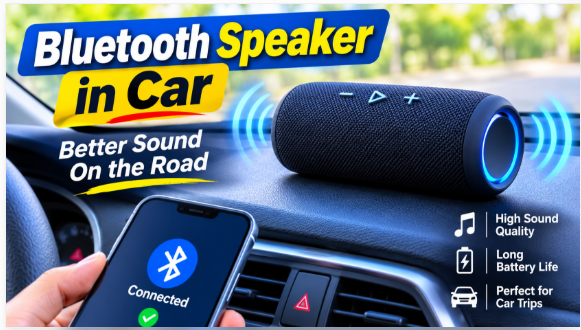
Quick answer: Here’s how to use Bluetooth speaker in car: the easiest way is a portable Bluetooth speaker on the dashboard or clipped to the sun visor. Pair it with your phone and it plays music and hands-free calls through its own speaker. If you want the sound through the car’s own speakers instead, use an FM transmitter (any car with a radio) or a Bluetooth AUX adapter (any car with a 3.5mm AUX jack). Pair everything while parked, never while driving.
Your car’s stereo has no Bluetooth, the AUX cable keeps falling out, and holding the phone to your ear is illegal in Pakistan. Section 101-A bans hand-held phone use while driving, with fines from Rs 200 to Rs 15,000 depending on the province and the vehicle. A Bluetooth speaker is the cheapest fix: no new stereo, no wiring, no mechanic. You already own the speaker, your phone already has Bluetooth, and the whole setup takes five minutes. There are four ways to do it, and the right one depends on what your car already has — a radio, an AUX jack, or nothing at all. This guide covers all four, the safety rules that matter, and which one to pick for your car.
How to Use Bluetooth Speaker in Car
All four methods do the same job — they get your phone’s audio into your ears without a cable in your hand — but they get there differently. The portable speaker is the simplest: the speaker itself does everything, and it works in any car. The FM transmitter and the AUX adapter both use your car’s own speakers, so the sound is bigger, but they need a radio or an AUX jack. The new head unit is the permanent fix, and the most expensive one. Here’s the quick version: if you want the cheapest, fastest setup, use the portable speaker. If you want the best sound for the least money, use the AUX adapter — if your car has the jack. If your car has only a radio, use the FM transmitter. And if you drive an old car every day and want it done properly, replace the head unit. Our best Bluetooth speakers for cars guide rounds up the portable picks if you’re shopping.
How to Use Bluetooth Speaker in Car Safely
Before any method, get the safety part right — it’s the one thing every guide agrees on. Pair the speaker and set the volume while the car is parked, never while you’re driving. Put the phone in a dashboard holder or leave it in your pocket — never in your hand. A hands-free kit is not named in Pakistan’s Section 101-A, so a call on a Bluetooth speaker is not the same as holding the phone. But a driver distracted by a call can still be held responsible for careless driving — hands-free does not mean distraction-free. Keep the speaker where it can’t slide off the dashboard in a hard brake — a visor clip, a dashboard mount, or the cup holder is safer than a loose speaker on the dash. And keep the volume low enough that you can still hear a horn or a siren — if the music drowns out the road, it’s too loud. Our conference calls guide explains the mic side of hands-free calls in detail.
Method 1: A Portable Bluetooth Speaker on the Dashboard
This is the easiest method, and it works in every car — no radio, no AUX jack, no wiring needed. The speaker pairs directly with your phone and plays music and calls through its own speaker and mic.
- Put the speaker in pairing mode. Turn it on, then hold its Bluetooth button for 3 to 5 seconds until the light flashes. Our pairing guide explains the pairing steps in detail.
- Pair it with your phone. On your phone, go to Bluetooth settings and select the speaker. Once paired, the phone reconnects automatically every time you get in the car.
- Mount it securely. Clip it to the sun visor, or set it in a dashboard mount or the cup holder. Don’t leave it loose on the dashboard — it slides in a hard brake.
- Keep it charged. Plug it into the car’s USB port or a 12V car charger on long drives. A speaker that dies mid-drive is worse than no speaker at all — our battery-life guide explains how long batteries last and when they go bad.
The trade-off is sound quality: a small portable speaker can’t match your car’s speakers, and road noise drowns out the bass at highway speed. But for city driving, podcasts, and calls, it’s more than enough — and it’s the only method that costs nothing if you already own a speaker. Where you put it matters too: our placement guide covers the best spots, and in a car the rule is the same — close to your ears, with a clear line of sight to the phone.
Method 2: FM Transmitter — Any Car With a Radio
If your car has only an FM radio — no AUX jack, no Bluetooth — an FM transmitter is the quickest path. It’s a small device that plugs into the car’s 12V outlet (the cigarette lighter socket), pairs with your phone over Bluetooth, and broadcasts the audio on an empty FM frequency that your car radio tunes into. It costs about $15 to $25, and it also charges your phone from the same socket.
- Plug the transmitter into the 12V outlet. It powers on automatically. Some models have a small screen showing the frequency; others have buttons and an LED.
- Pair your phone with the transmitter. On your phone, go to Bluetooth settings and select the transmitter’s name when it appears.
- Find an empty FM frequency. Turn on your car radio and scan for a frequency with nothing but static — 87.9 is a common empty spot, but it depends on your city. This is the step that decides the sound quality.
- Set the transmitter to the same frequency. Use its buttons to match the radio. The audio should come through the car’s speakers right away.
The honest downside is sound quality: FM is an analog broadcast, so the audio depends on how crowded the FM band is where you drive. In a city with strong stations on every frequency, you’ll hear hiss and interference — our cutting-out guide explains the interference causes in detail. If the sound keeps breaking up, try a different empty frequency, or move to the AUX method below. Most FM transmitters also have a built-in microphone for hands-free calls, and many have a USB port for charging the phone.
Method 3: AUX Adapter — Best Sound for the Money
If your car stereo has a 3.5mm AUX input — usually labelled AUX or Line-In, often in the centre console or glove box — a Bluetooth AUX adapter gives you the best sound for the least money. It’s a small device that plugs into the AUX jack, pairs with your phone over Bluetooth, and sends the audio straight into the car’s speakers through a wire. No radio broadcast, no interference, no static — just a clean analog signal.
- Plug the adapter into the AUX jack. Check the jack first — some older stereos hide it in the glove box, so plan the cable routing before you buy.
- Power it from USB or the 12V outlet. Most adapters need power from a USB port or a car charger, so keep a cable handy.
- Pair your phone with the adapter. On your phone, go to Bluetooth settings and select the adapter’s name.
- Select AUX on the car stereo. Press the Source or Mode button until the stereo shows AUX, then start streaming.
The sound is noticeably better than an FM transmitter because there’s no radio broadcast in the middle — the audio goes straight from the adapter to the speakers. The trade-off is the cable: the adapter sits on a wire, so it looks messier than an FM transmitter, and you need a spare USB port or 12V outlet for power. Some adapters also carry a microphone for hands-free calls — check the specs before buying, because not every adapter supports calls. If your car has both an AUX jack and a radio, pick this method over FM every time.
Which Method Fits Your Car?
Pick by what your car already has, not by what’s newest. If your car has an AUX jack, use the AUX adapter — best sound, least money. If it has only a radio, use the FM transmitter — it works everywhere, with the sound quality depending on how crowded the FM band is. If it has neither, or you want zero setup, use the portable speaker — it works in any car and costs nothing if you already own one. And if you drive the car every day and want the permanent fix, replace the head unit with a Bluetooth-enabled stereo. It’s the most expensive option, but it gives you full Bluetooth, steering-wheel controls, and the best sound of all. One last thing before you buy anything: check your car’s inputs first. Look for the AUX jack (centre console, glove box, or dashboard), test whether the radio has an empty FM frequency, and count your free USB ports and 12V outlets — the right method is the one your car already supports. And if you’re picking a speaker for the car, our buying guide lists battery life and size as two of the 7 checks. A small, light speaker fits a visor clip or a cup holder better than a big one.
The Bottom Line
The bottom line is simple: you don’t need a new car or a new stereo to get Bluetooth in the car. A portable speaker works in any car and costs nothing if you already own one. An AUX adapter gives the best sound for the least money if your car has the jack. An FM transmitter works in any car with a radio. Pair everything while parked, keep the phone out of your hand, and keep the volume low enough to hear the road — our best outdoor party speaker guide rounds up the portable picks if you’re shopping.
FAQs: How to Use Bluetooth Speaker in Car
How to use Bluetooth speaker in car?
Pair a portable Bluetooth speaker with your phone and mount it on the dashboard or visor. Or use an FM transmitter (any car with a radio) or a Bluetooth AUX adapter (any car with a 3.5mm AUX jack) to play through the car’s own speakers.
Is it legal to use a Bluetooth speaker while driving in Pakistan?
Section 101-A bans hand-held phone use while driving, with fines from Rs 200 to Rs 15,000 depending on the province and the vehicle. A hands-free Bluetooth speaker is not named in the law, but careless driving rules still apply if you’re distracted.
Which is better in a car: FM transmitter or AUX adapter?
The AUX adapter — the sound is cleaner because there’s no radio broadcast in the middle. The FM transmitter works in any car with a radio, but the sound depends on how crowded the FM band is where you drive.
Can I take hands-free calls on a Bluetooth speaker in the car?
Yes — most portable speakers, FM transmitters, and AUX adapters have a built-in microphone. Pair the speaker while parked, and answer calls with the speaker’s button or your phone’s voice assistant.
Why does my car Bluetooth speaker keep cutting out?
Usually interference or distance — the phone is too far from the speaker, or the FM frequency you picked has a station on it. Move the phone closer, or try a different empty FM frequency.
Does a Bluetooth speaker drain the car battery?
No — a portable speaker runs on its own battery, and an FM transmitter or AUX adapter draws very little power from the 12V outlet. Charge the speaker from the car’s USB port on long drives so it doesn’t die mid-trip.