
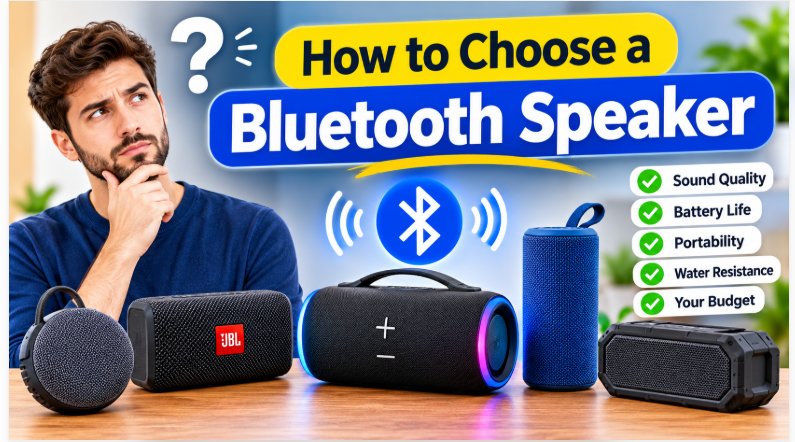
Quick answer: Here’s how to choose a Bluetooth speaker: check sound quality first (not watts), then real battery hours, size and weight, waterproof rating, codec support for your phone, and connectivity — and only then look at price. A great speaker gets the first five right; a famous brand name alone doesn’t. Run through the 7 checks below before you pay, and you’ll avoid the most common buyer’s regret: a loud-looking speaker that sounds thin, dies fast, or can’t survive a splash.
Walk into any speaker listing and you’ll see the same trap: big watt numbers, big discount badges, and a dozen models that look identical. The truth is simpler — most buyers only need to check seven things, and three of them matter more than everything else combined. Here’s the checklist, in the order that actually matters.
How to Choose a Bluetooth Speaker: The 7 Checks
- Sound quality — balanced, clear sound at normal volume, not just loudness.
- Battery life — real hours at normal volume, plus charging time.
- Size and weight — portable enough for how you’ll actually use it.
- Waterproof rating — IPX/IP rating matched to where you’ll use it.
- Codec support — the right codec for your phone (AAC for iPhone).
- Connectivity — Bluetooth version, multipoint, and an AUX backup.
- Price and warranty — pay for sound and battery, not for the logo.
Sound, Battery, and Size: The Big Three
Sound. Ignore the watt number on the box — watts don’t equal loudness or quality, as our wattage guide explains in detail. What matters is balanced sound: clear voices, bass that doesn’t drown everything else, and no distortion when you turn it up. If you can listen before buying, play a song you know well at medium volume — that’s where a bad speaker shows itself. Then turn it up to around 80%: a good speaker stays clean, while a poor one starts crackling or harsh. Also check whether the speaker plays in stereo or mono — two-driver stereo speakers sound wider, while small single-driver ones often sound flat no matter what the box claims. Our sound quality guide also explains why placement and EQ change what you hear, even on a good speaker.
Battery. Treat the claimed hours with suspicion: makers usually test at low volume, so real-world playtime is often much shorter. Look for the battery size, check how long a full charge takes, and read the fine print on volume. A speaker that takes 5 hours to charge but plays for 10 is a worse deal than it looks — fast charging (even a quick top-up giving an hour or two of play) matters more than most people think. Our battery life guide shows what actually drains a speaker fastest, and why two speakers with the same claimed hours can last very differently.
Size and weight. A big speaker sounds bigger, but it stays home — and a speaker that stays home doesn’t get used. Be honest about where you’ll listen: pocket-sized for bags, medium for rooms and picnics, large only if it mostly lives in one place. Weight matters as much as size on a long day out.
Waterproof Rating, Codecs, and Connections
Waterproof rating. IP ratings look technical, but the idea is simple: IPX4 handles splashes, IPX7 survives a dunk, and IP67 adds dust protection. Match the rating to real life — poolside or beach means IPX7 or better, kitchen or desk means IPX4 is plenty. Our waterproof speakers guide explains the ratings in full, so you don’t pay for protection you’ll never need.
Codecs. The codec decides how much of your music survives the wireless trip — but only the codecs both devices share actually work. iPhone users need AAC; Android users benefit from aptX or LDAC. Don’t pay extra for a codec your phone can’t use. Our codecs guide compares them all, and the short version is: codec is a tiebreaker, never the reason to buy.
Connectivity. Check three things: a recent Bluetooth version (5.0 or newer is fine), multipoint if you switch between phone and laptop, and an AUX input as a backup for the day Bluetooth misbehaves. A speaker with all three covers nearly every situation.
How to Choose a Bluetooth Speaker on a Budget
Set your budget by use, not by brand. For casual listening at home, a mid-range speaker usually beats a cheap famous-brand one — the money goes into drivers and battery instead of the logo. For outdoor parties, spend on size and battery first, and check our roundup of the best outdoor party speakers before deciding. Whatever you spend, check the warranty: a one-year warranty is standard, and a speaker you’ll take outdoors deserves at least that. And if you’re torn between Bluetooth and a Wi-Fi smart speaker, our Bluetooth vs Wi-Fi guide settles which kind fits your home.
Mistakes to Avoid When Buying a Speaker
- Buying on watts alone. The biggest number on the box is marketing, not sound quality. Listen first, or trust detailed reviews over spec sheets.
- Ignoring the return policy. Sound is personal — a speaker can measure well and still not suit your ears. Buy from somewhere you can return it within a week or two.
- Paying for protection you don’t need. An IP67 rating is great for the beach and pointless for a desk. Match the rating to real life, not to the fear of a spill that will never happen.
- Paying for a codec your phone can’t use. LDAC and aptX mean nothing to an iPhone. Check what your phone supports before paying a premium for letters on a box.
The Bottom Line on Choosing a Speaker
Choosing a Bluetooth speaker comes down to this: sound first, battery second, size third — then waterproof rating, codec, connectivity, and price. Get those seven checks right and the brand almost doesn’t matter. Skip them, and even an expensive speaker can disappoint. Buy for how you’ll actually listen, not for the biggest number on the box.
FAQs: How to Choose a Bluetooth Speaker
What is the most important thing when choosing a Bluetooth speaker?
Sound quality at normal volume — balanced, clear sound without distortion. Battery life comes second, and size third. Everything else (brand, watts, extra features) matters less than these three.
How many watts do I need in a Bluetooth speaker?
Fewer than the box suggests. Watts measure power, not loudness or quality — a well-tuned 20W speaker often sounds better than a harsh 50W one. Judge by listening, not by the watt number.
Do I need a waterproof Bluetooth speaker?
Only if it will get wet. IPX4 is enough for splashes, IPX7 for pools and beaches. If your speaker lives indoors, don’t pay extra for a rating you’ll never use.
Does codec support matter when buying a speaker?
A little, not a lot. iPhone users should look for AAC; Android users benefit from aptX or LDAC. But a good speaker on basic SBC beats a poor speaker on LDAC — codec is a tiebreaker, not the deciding factor.
How much should I spend on a Bluetooth speaker?
For casual home listening, mid-range is the sweet spot — that’s where sound and battery are good without paying for a logo. For outdoor parties, spend more on size and battery. Always check the warranty before paying.
Should I buy a Bluetooth or Wi-Fi speaker?
Bluetooth for portable, outdoor, and phone-based listening; Wi-Fi for multi-room audio and voice control at home. Many smart speakers offer both, which removes the dilemma entirely.