
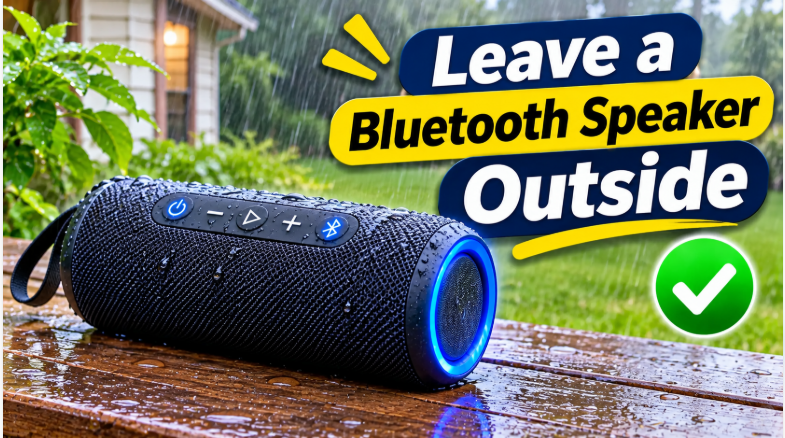
Quick answer: Can you leave a Bluetooth speaker outside? For a few hours in dry weather, yes — any speaker can sit on a patio for an afternoon. Overnight or all season, no: rain gets in through open port covers, cold below freezing drains the battery fast, and sun and heat wear out the seals. Bring it indoors when you’re done, and it will last years longer.
The question usually comes up at the end of a barbecue. The music is still playing, the sky looks fine, and bringing the speaker inside feels like a chore. So it stays out — and then it rains at 2 a.m., or the night turns cold, or it bakes in the sun all the next day. A Bluetooth speaker is built to survive a party, not a season. This guide explains what the weather actually does to it, hour by hour and season by season, and the simple habits that keep it alive.
Can You Leave a Bluetooth Speaker Outside?
The short version is time. A few hours outside in dry weather is what these speakers are made for — a patio, a picnic, a pool party. The trouble starts when “a few hours” turns into “all night” or “all summer”. Three things attack a speaker left outside: water, cold, and sun. Each one works slowly, and none of them shows up the first time. The speaker still plays the next day, so it feels fine — until the battery holds half a charge, or the sound goes muffled, or the charging port stops working. The rest of this guide takes the three threats one at a time, so you know exactly which nights are safe and which ones aren’t.
Rain: What Your IP Rating Actually Allows
Your speaker’s IP rating is the first thing to check, and the second number is the one that matters for rain. The first digit is dust protection, the second is water. Here is what the common ratings actually mean in the rain:
| Rating | What it survives |
| No rating / IPX0 | Nothing — keep it dry, even a splash can kill it |
| IPX4 | Light rain and splashes from any direction |
| IPX5 | Steady rain, but not submersion or a hose blast |
| IPX7 / IP67 | Heavy rain and a brief dunk in 1 metre of water for 30 minutes |
Two catches most people miss. First, the rating only holds when every port cover is fully closed — an open charging port turns an IP67 speaker into a bucket with a hole in it. Sony’s own manuals say the same thing: the waterproof rating applies with the cap fastened securely, and water damage from misuse isn’t covered by the warranty. Second, “water-resistant” is not “waterproof”. A speaker can survive rain and still fail if it sits in a puddle overnight, because standing water finds the seams that rain never reaches. If your speaker has no IP rating at all, treat any rain as a reason to bring it in. Our waterproof buying guide explains the ratings in more detail, and our buying guide lists the IP rating as one of the 7 checks before you buy.
Cold Weather: The Battery Problem
Cold is the quietest killer of the three, because the speaker looks perfectly fine while it happens. Lithium-ion batteries lose capacity as the temperature drops. Below 0°C (32°F), you can lose 20 to 40 percent of your playtime, and the voltage can drop far enough that the speaker shuts itself off while the battery still shows charge. The cold itself doesn’t usually destroy the battery in one night. The real damage comes from charging a frozen battery: never charge a speaker below 0°C, because charging lithium cells in the cold degrades them permanently. Bring the speaker inside and let it warm up to room temperature first.
Frost brings a second problem: condensation. When a cold speaker comes into a warm room — or when the morning sun hits a speaker left out overnight — moisture forms inside the enclosure, on the drivers and the circuit board. That dampness is what corrodes contacts over weeks, not the cold itself. So if the speaker spent a cold night outside, wipe it dry before you bring it in, and wipe the ports and grille again before you store it. If it already got soaked, our got-wet guide walks through the drying steps, and our battery-life guide explains how cold and heat change the hours you actually get.
Sun and Heat: The Slow Damage
Sun damages a speaker in two ways, and both are slow. First, the heat: above about 38°C (100°F), a lithium battery ages faster with every hot day, and a speaker left in direct sun can swell its battery over a summer. Sony’s manuals say not to use or leave their speakers outside 5°C to 35°C — outside that range, the speaker may shut itself down to protect its own circuits. Second, the UV light itself: months of sun break down the rubber seals and gaskets that keep water out, so a speaker that survived rain last summer starts leaking this summer. The seals age even when the speaker looks new.
The fix is simple and costs nothing: shade. Put the speaker under a table, a chair, or a tree — anywhere the sun doesn’t hit it directly for hours. Never leave it on a car dashboard or a metal table in full sun, and never store it in a hot car, because a parked car gets far hotter than the air outside. A speaker that lives in the shade and comes inside at night will outlast one that bakes on a sunny patio by years, even if both have the same IP rating.
How to Leave a Bluetooth Speaker Outside Safely
If the speaker has to stay out for a party or an afternoon, these five habits cover almost all of the risk:
- Check the port covers. Close every cover — charging port, AUX jack, anything with a flap — before the speaker goes outside. An open cover voids the whole IP rating.
- Keep it off the ground. Put it on a table, a bench, or a shelf. Ground contact pulls cold and damp straight into the speaker, and a puddle forms under it first.
- Give it shade. A covered porch, an umbrella, or a tree is enough. Direct sun for hours is what ages the battery and the seals.
- Keep it dry while charging. Never charge a speaker in the rain or with wet ports. Water and charging together are the one combination that can genuinely damage the circuits.
- Bring it in at night. Night brings dew, frost, and the coldest hours — plus it’s when a speaker is most likely to be stolen. Inside is warmer, drier, and safer. Our placement guide covers the best spots indoors and out.
Can You Leave a Bluetooth Speaker Outside Overnight?
Overnight is where “outside for a while” turns into real risk, and the answer depends on the night. A warm, dry summer night under a covered porch: an IPX5 or better speaker will almost certainly be fine. A rainy night, a frosty night, or a night near freezing: bring it in, whatever the rating says. Dew is the part people forget — even on a clear night, moisture settles on everything, and it settles inside the speaker’s grille and ports too. And a speaker left out overnight is also a speaker someone can walk away with, which no IP rating protects against.
The honest rule is this: if you wouldn’t leave your phone out there overnight, don’t leave the speaker either. Both have the same lithium battery, the same charging port, and the same weakness to cold and water. A speaker is tougher than a phone, but only by a little — and it’s a lot easier to replace a phone habit than a speaker habit. If you want music outside every evening without the nightly carry, a wired outdoor speaker mounted under an eave is the right tool for the job, because it has no battery to freeze and no port to leak. Our best outdoor party speaker guide rounds up the portable picks, and the wired ones, for exactly that setup.
What to Do If Your Speaker Got Left Outside
It happens — the party ran late, or the forecast was wrong. Don’t panic, and don’t charge it yet. First, bring it inside and wipe it dry with a cloth, including the grille and the port covers. Second, leave the port covers open for an hour so any trapped moisture can dry out — then close them again for storage. Third, let the speaker warm up to room temperature on its own; don’t put it on a heater or in direct sun to speed it up. Fourth, only then plug it in and test it. If the sound is muffled or the speaker won’t turn on, give it a full day to dry before you decide it’s broken. Read our got-wet guide for the full recovery steps, plus our cleaning guide for the grille and ports. If it spent the night in a puddle or in freezing rain, the battery may need a check too — our battery replacement guide explains when a new battery is worth it and when it isn’t.
The bottom line is simple: a Bluetooth speaker is an outdoor guest, not an outdoor resident. A few hours in dry weather is fine, a rainy or freezing night is not, and sun ages it even on dry days. Close the port covers, keep it off the ground and out of direct sun, and bring it inside at night. Do those four things and the speaker will sound the same next summer as it does today.
FAQs: Can You Leave a Bluetooth Speaker Outside?
Can you leave a Bluetooth speaker outside?
For a few hours in dry weather, yes. Overnight or all season, no — rain, cold below freezing, and sun wear it out. Bring it indoors when you’re done.
Can a Bluetooth speaker stay outside in the rain?
Only if its IP rating allows it — IPX4 for light rain, IPX5 for steady rain, IPX7 for heavy rain — and only with every port cover fully closed. No rating means no rain at all.
Can cold weather damage a Bluetooth speaker?
Yes. Below 0°C the battery loses 20 to 40 percent of its playtime and can shut off early. Never charge a cold speaker until it has warmed up to room temperature.
Can I leave my Bluetooth speaker outside overnight?
On a warm, dry night under cover, an IPX5 or better speaker is usually fine. On a rainy or freezing night, bring it in — dew, frost, and theft are the risks no rating covers.
Does sun damage a Bluetooth speaker?
Yes, slowly. Heat above about 38°C ages the battery faster, and UV light breaks down the rubber seals that keep water out. Keep it in the shade.
What should I do if my speaker got rained on?
Bring it in, wipe it dry, leave the port covers open for an hour, and let it warm up before charging. If the sound is muffled, give it a full day to dry.