
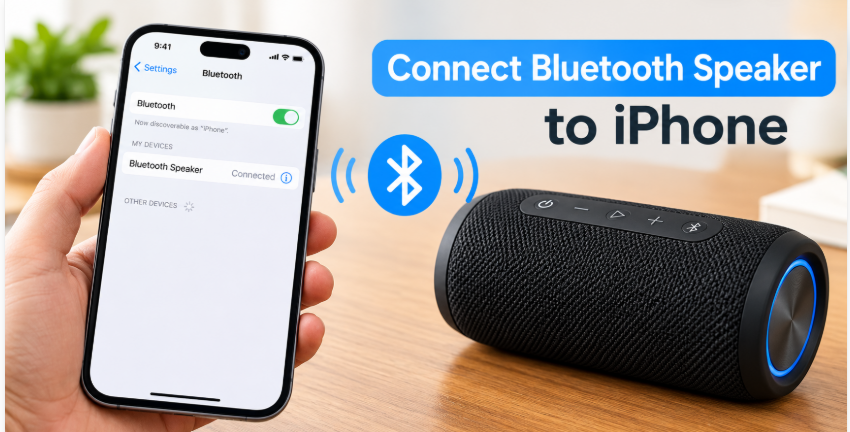
Quick answer: Here’s how to connect Bluetooth speaker to iPhone: go to Settings → Bluetooth and turn it on, put your speaker into pairing mode (usually a long press on the Bluetooth or power button until it blinks), then tap your speaker’s name under Other Devices. When it says Connected, play any song to test it. The whole thing takes under a minute — and if your speaker doesn’t appear, it’s almost always because pairing mode wasn’t on, not because anything is broken.
Connecting a Bluetooth speaker to an iPhone is one of the simplest tech jobs there is — until the speaker doesn’t show up in the list, and then it feels impossible. The good news: the process is the same on every iPhone, from older models to the latest ones, and nearly every problem has the same handful of fixes. Here’s how to connect Bluetooth speaker to iPhone, step by step, plus the iPhone-only limits nobody tells you about until after you’ve bought the speaker.
Before You Start: 3 Quick Checks
- Charge your speaker. A speaker with a nearly dead battery often won’t enter pairing mode at all. Plug it in for a few minutes if you’re unsure.
- Stay close. Keep the speaker within a metre or two of your iPhone for the first pairing. You can move it further away afterwards.
- Disconnect other devices. If your speaker is already connected to a laptop or another phone, it may refuse a new connection. Turn the other device’s Bluetooth off, or disconnect the speaker from it first.
How to Connect Bluetooth Speaker to iPhone
- Put the speaker in pairing mode. Turn the speaker on, then press and hold its Bluetooth button (or the power button, on speakers without a dedicated Bluetooth button) until you hear a tone or see a blinking light. Blinking means “I’m ready to pair” — a steady light usually means it’s already connected to something else. The exact button varies by brand — on a JBL Flip it’s a dedicated Bluetooth button, while on a Bose SoundLink you hold the power button down for a few seconds — so check your manual if you’re unsure.
- On your iPhone, open Settings → Bluetooth. Make sure the Bluetooth switch at the top is on (green). You can also open Control Center and long-press the Bluetooth icon, but the Settings route is more reliable for a first-time pairing.
- Wait for your speaker’s name to appear under Other Devices. This usually takes a few seconds. If nothing appears, check that the speaker is still blinking — pairing mode times out after a minute or two on many speakers, so you may need to trigger it again.
- Tap the speaker’s name. Your iPhone will connect within seconds and the speaker will move up to My Devices with the word Connected next to it.
- Play something. Open any music or video app and press play. If sound comes from your phone instead of the speaker, open Control Center, long-press the audio card, and check that your speaker is selected as the output.
That’s it — there’s no app to install and no code to enter for most speakers. If your speaker asks for a PIN, try 0000 or 1234; those are the standard defaults, and the manual will say if yours is different.
How to Connect Bluetooth Speaker to iPhone Again
After the first pairing, your iPhone remembers the speaker. Next time, just turn the speaker on near your phone and it should connect by itself within a few seconds — no Settings trip needed. If it doesn’t, open Settings → Bluetooth and tap the speaker’s name under My Devices to connect manually. If even that fails, tap the small (i) next to the speaker’s name, choose Forget This Device, and run through the first-time steps again. Forgetting and re-pairing fixes most stubborn connections, and it takes less than a minute.
iPhone Bluetooth Speaker Problems (and Fixes)
Speaker doesn’t appear in the list. First, confirm pairing mode is actually on (blinking light, not steady). Then check that the speaker isn’t already connected to another device. If both are fine, turn your iPhone’s Bluetooth off and on again, then retry.
It connects but there’s no sound. Check two volumes: your iPhone’s volume and the speaker’s own volume buttons — they work independently, and one of them is often at zero. Then check Control Center’s audio output, as above.
Sound keeps cutting out. This is usually distance or interference, not a fault. Move closer, keep your phone out of a pocket or bag, and move away from busy Wi-Fi routers and microwaves, which share the same wireless space.
Try the Airplane Mode trick. Turn Airplane Mode on, restart your iPhone, then turn Airplane Mode off and re-enable Bluetooth. This resets all of your iPhone’s wireless radios at once and clears stuck pairings more often than you’d expect — try it before anything drastic.
Nothing works at all. Restart both devices — turn your iPhone off and back on, and do the same with your speaker — then forget and re-pair the speaker. If that fails, check your speaker’s manual for its factory reset or clear-pairings button combination. This wipes the speaker’s saved pairings, so you’ll need to pair it fresh afterwards, but it fixes “stuck” Bluetooth more often than people expect. As a last resort, reset network settings (Settings → General → Transfer or Reset iPhone → Reset → Reset Network Settings) — this clears all saved Bluetooth and Wi-Fi connections, so only use it when nothing else has worked. Note that this also erases saved Wi-Fi passwords.
iPhone Bluetooth Limits You Should Know
iPhones only use two codecs: AAC and SBC. Even if your speaker supports fancier codecs, your iPhone can’t use them — it will use AAC with compatible speakers and SBC otherwise. Our Bluetooth codecs guide explains what that means for sound quality, and the short version is: don’t pay extra for LDAC or aptX support if you only use an iPhone.
An iPhone can’t play to two Bluetooth speakers at once. Unlike some Android phones with dual-audio features, iOS has no built-in way to send music to two speakers simultaneously. If you want two speakers playing together, you need the speakers’ own pairing system — our pairing guide covers TWS, PartyBoost, and the other options.
One audio output at a time. Your iPhone sends sound to one Bluetooth device at a time. If music suddenly switches back to the phone speaker, something else (like your car or earbuds) grabbed the connection — check Control Center to switch it back.
Tips for Better Sound on iPhone
- Turn the iPhone volume up high, then control loudness on the speaker. A low phone volume sent to a loud speaker sounds worse than a strong signal turned down at the speaker.
- Place the speaker properly. A speaker on the floor in a corner sounds muddy no matter what phone you use — our sound quality guide covers EQ and placement tweaks that make a bigger difference than any setting on the phone.
- Keep iOS updated. Apple fixes Bluetooth bugs in software updates, and an old iOS version is a surprisingly common cause of pairing trouble.
- Check for speaker firmware updates too. If your speaker has a companion app, open it and check for firmware updates — makers fix pairing bugs this way, just like Apple does with iOS.
The Bottom Line on Connecting a Speaker to iPhone
Connecting a Bluetooth speaker to an iPhone comes down to one rule: speaker in pairing mode, iPhone Settings → Bluetooth, tap the name, done. Everything else — forgetting and re-pairing, checking Control Center’s output, knowing the AAC-only limit — is just for the days it doesn’t work first try. And if you’re setting up other devices too, our TV connection guide follows the same simple pattern. For days when you’re choosing a speaker rather than connecting one, our roundup of the best outdoor party speakers is the place to start.
FAQs: How to Connect Bluetooth Speaker to iPhone
Why won’t my iPhone find my Bluetooth speaker?
Almost always because the speaker isn’t in pairing mode — look for a blinking light, not a steady one. Also check the speaker isn’t already connected to another device, and turn your iPhone’s Bluetooth off and on again before retrying.
Do I need an app to connect a Bluetooth speaker to my iPhone?
No. Standard Bluetooth pairing works through Settings → Bluetooth with no app needed. Some brands offer companion apps for EQ or firmware updates, but they’re optional, not required for connection.
Why does my iPhone connect but play no sound?
Check both volumes (iPhone and speaker buttons work independently), then check Control Center’s audio output selection. If sound still comes from the phone, forget the speaker in Settings → Bluetooth and pair it again.
Can I connect two Bluetooth speakers to my iPhone at once?
Not natively — iOS sends audio to one Bluetooth device at a time. To play on two speakers together, use the speakers’ own pairing system (like TWS or PartyBoost), covered in our pairing guide.
Does my iPhone support LDAC or aptX?
No. iPhones support AAC and SBC only, so an iPhone will never use LDAC or aptX no matter what the speaker supports. For iPhone users, AAC support is all a speaker needs.
How do I disconnect a Bluetooth speaker from my iPhone?
Open Settings → Bluetooth, tap the (i) next to the speaker, and choose Disconnect for a temporary break, or Forget This Device to remove it completely. Turning the speaker off also disconnects it.