
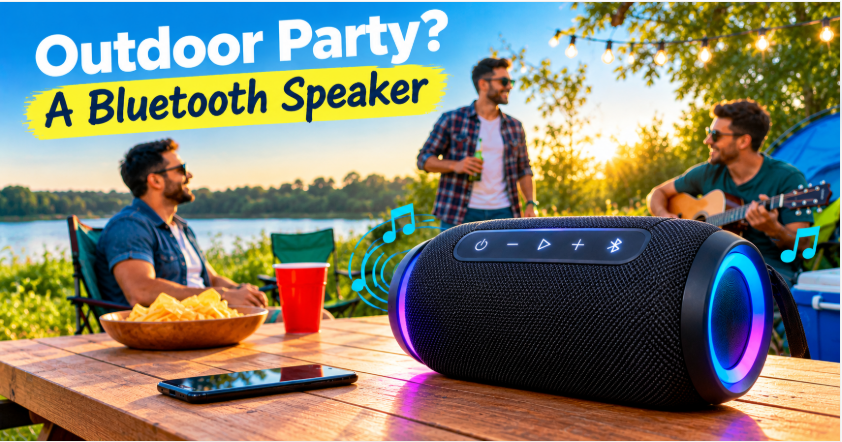
How many watts do you need for an outdoor party with a Bluetooth speaker? a picnic or a few friends, 10–20 watts RMS is enough. For a small backyard party of 10–20 people, get 30–50 watts RMS. For 20–40 guests, you need 80–140 watts RMS. And for a big open ground with 40+ people, look at a 200-watt party speaker—or pair two medium speakers instead. Always compare RMS watts, never the peak watts printed in big letters on the box.
Last summer, a friend brought a tiny 10-watt outdoor party Bluetooth speaker to a rooftop birthday. Great little speaker, honestly. It sounded sweet indoors. But the moment twenty people started talking, laughing, and moving around outside, the music just vanished. The speaker kept distorting. And by 9 pm the battery gave up too.
The outdoor party Bluetooth speaker was not bad. It was simply the wrong size for the job.
That is what this guide fixes. By the end, you will know exactly how many watts your party needs, why the number on the box often lies, and which mistakes make even a powerful speaker sound weak outdoors. A speaker that fills a room can disappear outdoors. Open-air swallows sound—that is why wattage matters more outside.
What Does Wattage Mean in a Speaker?
A watt is a unit of power. In simple words, wattage tells you how much power the speaker can use to move air and make sound. More power usually means the speaker can play louder and fill a bigger area before the sound starts to break up.
Also Read Reset a Bluetooth Speaker
RMS Watts vs Peak Watts: The Number That Actually Counts
Outdoor party Bluetooth speaker brands print two different numbers:
RMS watts—the power the speaker can handle continuously, minute after minute. This is the honest number.
Peak watts—the power it can survive for a split second. This is the marketing number.
A budget speaker shouting “200W!” So the first rule of this whole guide is simple: compare RMS to RMS, and ignore peak watts completely.
Why Doubling the Watts Does Not Double the Loudness
Here is the fact most buying guides skip. Doubling the wattage raises the volume by only about 3 decibels (dB)—a difference you can notice, but it is nowhere near “twice as loud.” As Sweetwater’s wattage guide explains
So a 100-watt speaker is not twice as loud as a 50-watt speaker. It is a little louder—and, more importantly, it stays cleaner at high volume, with deeper bass and less distortion. That headroom, not raw loudness, is what you are really paying for.
How Many Watts Do You Need for an Outdoor Party?
Now the main question. These numbers are for portable outdoor party a Bluetooth Speaker (not wired PA systems), based on how far sound actually travels in open air:
| Your party | Space | Watts you need (RMS) | Speaker class |
| 2–6 people | Picnic, camping, balcony | 10–20W | Small portable speaker |
| 10–20 people | Small backyard or rooftop | 30–50W | Medium speaker, e.g. JBL Charge 6 (45W RMS) |
| 20–40 people | Regular backyard party | 80–140W | Boombox class, e.g. JBL Boombox 3 (136W RMS on battery) |
| 40+ people | Big lawn, beach, open ground | 200W, or two paired speakers | Party speaker, e.g. Soundcore Rave 3S (200W) |
Speaker size is a rough wattage clue: small outdoor party a Bluetooth Speaker sit near 10–20W, medium ones near 30–50W, and boombox-style speakers go well past 100W.
Small Gatherings: 10–20 Watts Is Honestly Enough
If the outdoor party has a Bluetooth speaker that sits within a few feet of everyone—a picnic blanket, a camping table, or a balcony with four friends—you do not need power. You need clarity at low volume. A clean 15-watt speaker beats a cheap 40-watt one here, every single time, because nobody is shouting over the music anyway.
Backyard Parties of 10–20 People: Aim for 30–50 Watts
This is the sweet spot for most homes. The JBL Charge 6 is a good reference point: its official rating works out to 45 watts RMS in total, which is exactly why it handles small parties without struggling—and why it runs out of breath at bigger ones.
Bigger Parties of 20–40 People: Step Up to 80–140 Watts
Once the outdoor party Bluetooth speaker crowd crosses twenty, background noise becomes your real enemy. People, laughter, a road nearby—a medium speaker have to fight all of it. This is boom box territory. Take the JBL boom box 3: JBL’s official specifications list 136 watts RMS total on battery power (and 180 watts RMS when plugged in). Notice the gap between the battery and plugged-in numbers—many speakers quietly play weaker on battery, and brands rarely highlight that.
40+ People or a Big Open Ground: 200 Watts, or Pair Two Speakers
For a wedding lawn, a beach party, or a farm gathering, a single portable speaker—any single portable speaker—will leave the far side of the crowd in silence. You have two good options: a dedicated party speaker like the 200-watt Sound Core Rave 3S, or two medium speakers paired in stereo and placed on opposite sides. Honestly, the outdoor party Bluetooth speaker paired option often sounds better, because the music reaches everyone instead of blasting the front row and fading at the back.
Things That Change the Answer More Than Watts
Two speakers with the same watt rating can sound completely different outdoors because of these five things:
-
Speaker Placement (Free Loudness, No Extra Watts)
Never put the speaker on the ground behind your guests. Raise it to ear level—a table or a stand—and keep it a little away from walls and corners if the bass gets boomy, or closer to a wall if you want the bass boosted for free. Good placement can make a 40-watt speaker sound like a 60-watt one. Bad placement does the opposite.
-
How Far Your Guests Are From the Speaker
Sound drops fast outdoors. Roughly speaking, every time the distance doubles, the volume drops noticeably—there are no walls to bounce the sound back to you. A speaker that feels loud at 6 feet can feel half as loud at 25 feet. This is why crowd size matters less than crowd spread.
-
Battery Life at Party Volume, Not at Half Volume
Brands test battery life at moderate volume. If your party runs four hours, buy a speaker rated for at least ten. And check how battery drain behaves on your model before the big day, because a dead speaker at 10 pm ends the party faster than low watts ever will.
-
Water and Dust Protection (IP Rating)
Outdoors means splashes, rain, and dust. Look for IP67 or IP68 on any speaker that will live near a pool or on a lawn. IPX4 handles light splashes only.
-
Bluetooth Range and Pairing
If the DJ’s phone keeps walking away from the outdoor party, a Bluetooth speaker, the music keeps cutting out—and no wattage fixes that. A stable connection across your yard, and the option to pair a second speaker later, are worth more than ten extra watts on a spec sheet.
Real Speakers, Real Watts: What the Numbers Look Like
the actual RMS ratings of speakers we have already covered in our round-up of outdoor and party Bluetooth speakers:
| Speaker | Real output | Best party size |
| JBL Charge 6 | 45W RMS | 10–20 people, small backyard |
| JBL boom box 3 | 136W RMS on battery · 180W RMS plugged in | 20–40 people, full backyard party |
| Sound core Rave 3S | 200W | 40+ people, large open spaces |
See the pattern? Each jump in party size needs roughly a jump in speaker class — not just a slightly bigger version of the same thing.
Wattage Mistakes That Ruin Outdoor Parties
- Buying the peak number. A box that screams “200W PEAK” can be a 20-watt RMS speaker in disguise. Check the spec sheet for RMS before you pay.
- Running a small speaker at 100% all night. Full volume on a small speaker means distortion and a battery that dies mid-party. A bigger speaker cruising at 60% sounds cleaner and lasts longer.
- Buying watts and forgetting the weather. A powerful indoor speaker with no IP rating is one rain shower away from becoming a very expensive paperweight.
The 30-Second Wattage Picker
Still unsure? Answer three questions:
- How many people? Under 10 → 10–30W. 10–20 → 30–50W. 20–40 → 80–140W. Over 40 → 200W or two speakers.
- How open is the space? Open ground or beach → take the higher end.
- How long is the party? Over 3 hours → prioritise battery rating and take the bigger speaker, so it never has to run at full blast.
That is it. Party size, open space, party length. Get those three rights and the watt number chooses itself.
Conclusion
For most backyard parties, a 30–50 watt RMS Bluetooth speaker is the honest sweet spot. Go smaller for picnics, step up to 80–140 watts when the guest list crosses twenty, and stop expecting one portable speaker to cover a crowd of fifty — pair two, or buy a proper 200-watt party speaker. Compare RMS watts only, raise the outdoor party a Bluetooth Speaker to ear level, and let the headroom do the rest.
FAQs
How many watts do I need for an outdoor party?
For 40 or more people in an open space, use a 200-watt party speaker or pair two medium outdoor party a Bluetooth Speaker.
Is a 50-watt Bluetooth speaker loud enough for a party?
Yes, for a small to medium backyard party of up to about 20 people. A good 50-watt RMS speaker stays clear over normal conversation. For bigger crowds or open ground, it will sound thin at the edges.
Is 100 watts loud for a Bluetooth speaker?
Yes. A 100-watt RMS outdoor party a Bluetooth Speaker is boom box class. It can cover a regular backyard party of 20–40 people with room to spare, and it will sound cleaner than a 40-watt speaker because it is not working at its limit.
What is the difference between RMS and peak watts?
RMS watts are the outdoor party a Bluetooth Speaker continuous power a speaker can actually deliver. Peak watts are a split-second maximum used for marketing. Always compare speakers by RMS watts — a “200W peak” speaker may only be 20W RMS.
Does doubling the watts make a speaker twice as loud?
No. Doubling the wattage adds only about 3 dB, which is a noticeable step, not double the loudness. It takes roughly ten times the power to sound twice as loud. Higher wattage mainly buys cleaner sound and stronger bass at high volume.
Can I use two smaller speakers instead of one big party speaker?
Yes, and for wide spaces it is often the better choice. Two 40–50 watt speakers paired in stereo and placed on opposite sides cover a crowd more evenly than one 100-watt speaker blasting from a single corner.
1 thought on “How Many Watts Do You Need for an Outdoor Party? A Bluetooth Speaker Wattage Guide”