
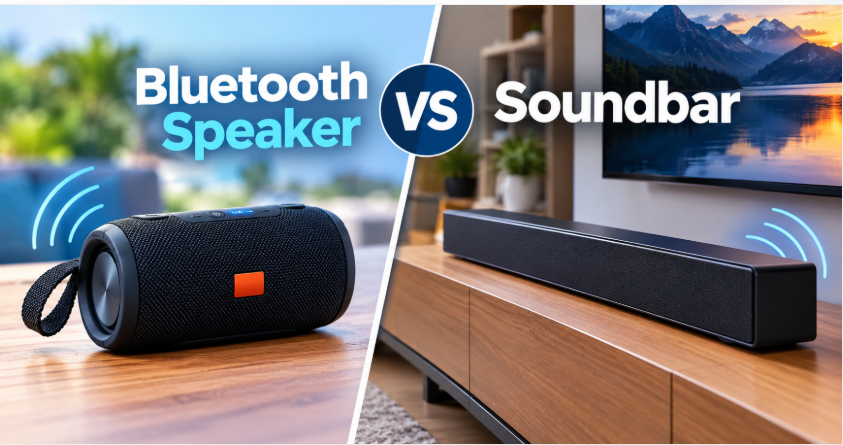
Quick answer: Bluetooth speaker vs soundbar — which is better? For TV and movies in one room, a soundbar usually wins: it sits under the TV, connects with one cable, and makes dialogue clearer. For music anywhere, parties, and outdoor use, a Bluetooth speaker wins: it goes wherever you go. If you mostly watch TV, buy the soundbar. If you mostly listen to music, buy the speaker.
You want better sound than your TV’s built-in speakers. That part is easy — almost anything beats them. The hard part is choosing between the two obvious upgrades sitting in front of you: a soundbar that lives under the TV, or a Bluetooth speaker you already own (or could buy for less). They look like they do the same job. They don’t. Each one is better at a different thing, and buying the wrong one is how people end up with a speaker gathering dust — or a soundbar they never move.
This guide compares a Bluetooth speaker vs soundbar honestly: sound quality, bass, dialogue, price, setup, and portability — then tells you exactly which one fits your room and your habits.
Bluetooth Speaker vs Soundbar at a Glance
Here is the short version before the detail:
- Best for TV and movies: soundbar — wider soundstage, clearer dialogue, one-cable setup.
- Best for music everywhere: Bluetooth speaker — portable, works in any room, and goes outside.
- Best on a tight budget: Bluetooth speaker — decent ones start far cheaper than decent soundbars.
- Best for a clean living room: soundbar — it mounts under the TV and disappears into the setup.
- Best for parties: Bluetooth speaker — battery-powered, portable, and easy to pair in twos for stereo.
| Feature | Bluetooth Speaker | Soundbar |
| Best for TV | Good for casual viewing | Best — clearer dialogue, wider sound |
| Best for music | Best — portable, tuned for music | Good, but stays in one room |
| Bass | Surprising for its size, limited by physics | Deeper, especially with a subwoofer |
| Surround sound | No | Yes — virtual surround, Dolby Atmos, DTS:X |
| Price | Lower, and you may already own one | Higher, especially with a subwoofer |
| Setup | Pair and play, no cables | One HDMI ARC or optical cable |
| Portability | High — any room, outdoors | None — it lives under the TV |
| Room size | Small rooms, one or two listeners | Medium-large rooms, several viewers |
Sound Quality in Bluetooth Speaker vs Soundbar
For TV dialogue, the soundbar has a real advantage. Soundbars are built wide on purpose: separate drivers spread left, center and right, and many have a dedicated center channel just for voices. That’s why whispered dialogue that vanishes on TV speakers suddenly becomes clear on a soundbar. A single Bluetooth speaker, no matter how good, plays everything from one box — voices, music and effects all competing from the same drivers.
For music, the gap closes fast. A good Bluetooth speaker sounds rich and full for songs, and many people honestly prefer it for music because it’s tuned for exactly that. Where the soundbar pulls ahead again is movies: wider separation makes action scenes feel bigger, and soundbars with a wireless subwoofer add a depth a single portable speaker can’t match. If your main use is movie nights, the soundbar earns its place. If it is mostly playlists, the speaker holds its own — and our guide to connecting a Bluetooth speaker to a TV shows how close you can get with the speaker you already have.
Movies also bring one soundbar-only feature into play: surround sound. Many soundbars simulate surround audio with virtual surround, Dolby Atmos, or DTS:X — sound that feels like it comes from different directions, not just from the front. A single Bluetooth speaker can’t do that; its sound is front-facing by design. Soundbars also commonly include dialogue enhancement modes, which push voices forward without raising the overall volume — a genuine help for late-night viewing, when you want every word clear but the rest of the house asleep.
Bass: Which One Actually Thumps?
Soundbars win on bass more often than not — especially the ones that come with a separate wireless subwoofer. That big box in the corner handles the low frequencies properly, so explosions rumble and music has weight. A Bluetooth speaker relies on small drivers and clever tuning; the best ones (JBL, Bose, Sony’s larger models) produce surprising bass for their size, but physics is physics — a small box can’t move as much air as a subwoofer.
That said, bass is also about placement. A speaker shoved in a corner gains bass for free, while a soundbar crammed inside a TV cabinet loses it. Our speaker placement guide explains how much difference a few feet can make, whichever device you choose.
Price: What Do You Actually Get for Your Money?
This is where the Bluetooth speaker fights back hard. A genuinely good portable speaker costs far less than a genuinely good soundbar, and you probably already own one — which makes the speaker’s price effectively zero. Soundbars worth buying start higher, and the good ones with a subwoofer climb fast.
The honest way to think about it: if the budget is tight, a Bluetooth speaker connected to the TV gives you maybe 70% of the soundbar experience for a fraction of the price. If the budget stretches, a mid-range soundbar with a subwoofer is the bigger upgrade. And if you’re still choosing the speaker itself, our roundup of the best outdoor party speakers covers models that do double duty — TV sound indoors, party sound outdoors — which no soundbar can do.
Setup and Space: One Cable vs No Cables
Soundbar setup is simple but fixed: one HDMI ARC or optical cable from the TV, power, done. It lives under the TV permanently and the TV remote usually controls its volume. The catch is space — you need room under or in front of the TV, and a soundbar in a small bedroom can dominate the whole wall.
A Bluetooth speaker needs no cable at all and no permanent space. Pair it, play, put it back on the shelf when done. The trade-off is the occasional Bluetooth hiccup: pairing drops, the odd half-second of lip-sync delay, and remembering to charge it. If your speaker ever sounds too quiet on the TV, our fixes for a Bluetooth speaker that sounds too quiet cover the usual causes.
If lip-sync delay is your main annoyance, three fixes help: first, check whether your TV and speaker both support aptX Low Latency — a codec built to keep Bluetooth audio in sync; second, look in your TV’s sound settings for an audio delay (lip-sync) adjustment and nudge it until voices match mouths; third, if delay still bugs you, skip Bluetooth entirely and use a wired connection — most Bluetooth speakers have a 3.5mm AUX input, and some have an optical input, both of which remove the delay completely.
Portability: The Deciding Factor Most People Forget
This is the question that settles it for most buyers: will this sound ever need to leave the TV room? A soundbar never will. It’s furniture. A Bluetooth speaker goes to the kitchen, the bedroom, the balcony, the backyard barbecue — and on a trip. If you buy the soundbar and later want music outside, you’re buying a second device anyway. If you buy the speaker, it already does both jobs, just not quite as well for movies.
There is one middle path: two Bluetooth speakers paired in stereo. That gives you genuine left-right separation for movies and music, keeps everything portable, and often costs less than a soundbar with a subwoofer. Our guide to connecting two Bluetooth speakers together walks through the pairing options.
Room Size: Match the Device to Your Room
Room size matters more than people expect. In a small room or a studio apartment, a Bluetooth speaker is often all you need — the sound has nowhere far to travel, and a compact speaker fills the space easily without clutter. In a medium or large living room, especially when several people watch together, the soundbar’s wide shape spreads sound evenly so everyone hears the same thing, not just the person sitting closest to the speaker. Before buying, ask one simple question: will one person listen up close, or will a whole room listen from different seats? The answer points straight at the right device.
Can You Use Both at the Same Time?
Most TVs send sound to one output at a time — soundbar or Bluetooth speaker, not both — so running both together for the same movie is usually not possible without extra hardware. A few setups get around it with an audio splitter or a receiver, but for most people it’s an either-or choice. Pick the one that matches your main use, and let the other one cover the rooms the first cannot reach.
Which Should You Buy? A Simple Decision Guide
- Buy the soundbar if: your main use is TV and movies, the TV is in one living room, and you want the simplest daily experience with the clearest dialogue.
- Buy (or keep using) the Bluetooth speaker if: you listen to music in different rooms, you want sound outside, your budget is tight, or you already own a good speaker.
- Buy the speaker pair if: you want stereo separation and portability, and you don’t mind pairing two devices.
- Skip both and save if: you only watch the news and casual shows — TV speakers are bad, but not bad enough to spend money fixing for light use.
The Bottom Line on Bluetooth Speaker vs Soundbar
Still torn on Bluetooth speaker vs soundbar? Ask yourself one question: where will the sound live? If the answer is “in front of the TV, every night,” the soundbar is the better buy — wider sound, clearer dialogue, zero fuss. If the answer is “everywhere,” the Bluetooth speaker wins — one device for the TV, the kitchen, and the backyard. Neither choice is wrong; the wrong choice is buying the TV-room device for a portable life, or the portable device for a movie-room life.
FAQs: Bluetooth Speaker vs Soundbar
Is a soundbar better than a Bluetooth speaker for TV?
Yes, usually. A soundbar is wider, often has a dedicated center channel for dialogue, and connects to the TV with one cable. A Bluetooth speaker works fine for TV too, but voices are less clear and lip-sync delay is more common.
Can a Bluetooth speaker replace a soundbar?
For casual TV watching and music, yes — especially if you already own a good speaker. For serious movie nights, a soundbar with a subwoofer still sounds bigger and clearer.
Which is better for music, a speaker or a soundbar?
A Bluetooth speaker, in most cases. Speakers are tuned for music, they’re portable, and you can move them to wherever you are listening. Soundbars are tuned for TV first.
Is a soundbar worth it if I already have a Bluetooth speaker?
Only if TV and movies are your main use and you want clearer dialogue and deeper bass. If you mostly listen to music, or your budget is tight, the speaker you own is already doing the job.
Can I connect a Bluetooth speaker and a soundbar to the TV at the same time?
Most TVs output to one audio device at a time, so no — not without extra hardware like an audio splitter or receiver. Pick one as the main output.
Do soundbars have Bluetooth too?
Most modern soundbars do — you can stream music to them from your phone just like a Bluetooth speaker. The difference is that a soundbar stays put, while a Bluetooth speaker travels with you.